-
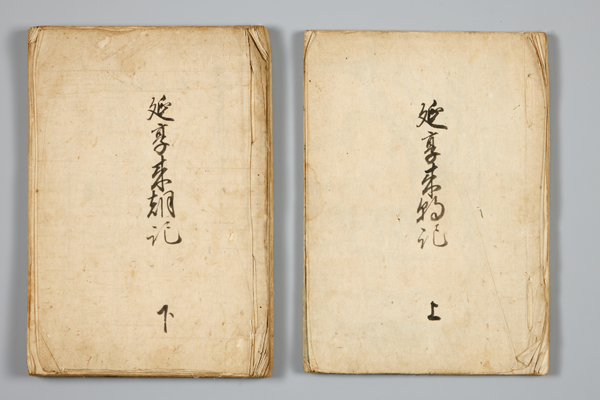
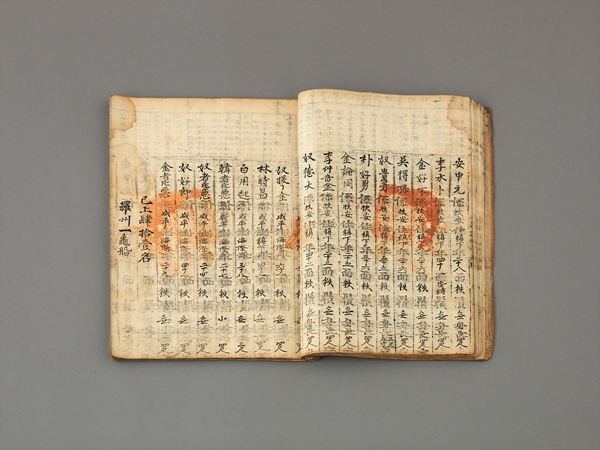
Record of Joseon Envoys to Japan
This document is related with the tenth diplomatic mission(Tongsinsa) of Joseon that was sent to Japan in 1748 to congratulate Tokugawa Ieshige on his inauguration as the ninth shogun. The document is a rare historic material that presents some of the characteristic features of the ceremonial protocols(uigwe) of the Joseon dynasty, and contains information about the mission, including its members and various related events, as well as illustrations of the “road clearing flag” and an equestrian event(masangjae).
japan / 18th century / paper
-
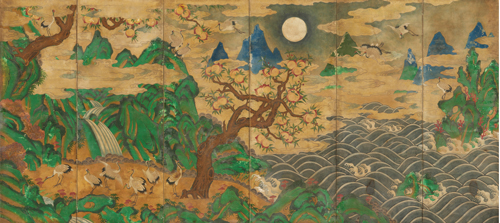
Folding Screen Illustrates Sea, Cranes and Peaches
This Buddhist painting, titled Sea, Crane, and Peaches of Immortality(Haehak Bandodo), depicts a crane flying over undulating sea waves and two large trees growing over blue rocks, with peaches(Bando) hanging beneath them. Mounted on a six-panel folding screen, the painting presents a fantastic view of the peaches of immortality at the Shining Lake(Yoji) ruled by the Queen Mother of the West (Seowangmo). Folding screens mounted with a painting were much favored by Joseon’s royalty and aristocracy, and were widely used to decorate their residences or celebrate auspicious events. The scene depicted in the painting symbolizes eternal life and health.
Republic of Korea / Late Joseon Dynasty / Paper
-
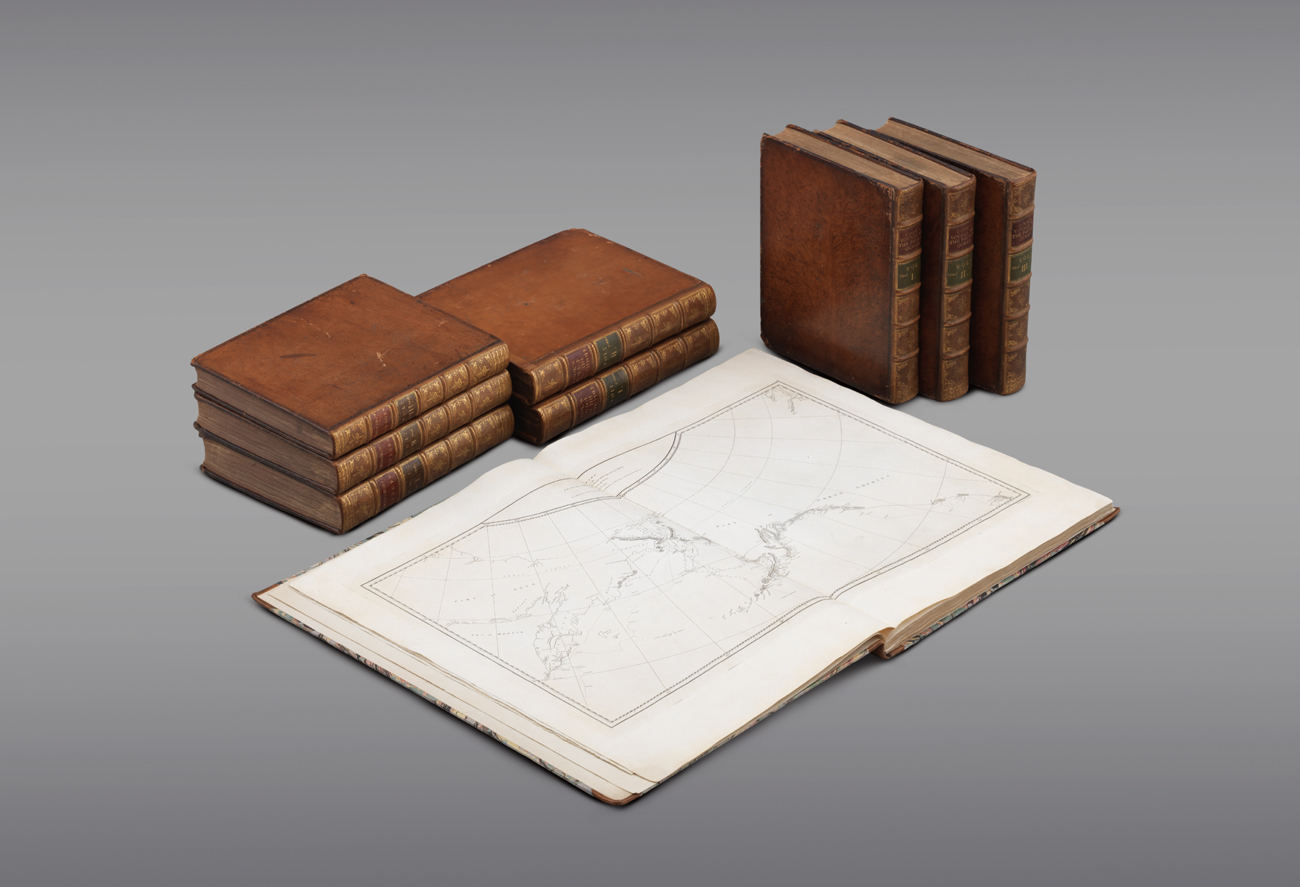
Account of Captain Cook’s Voyage
This Account of Captain Cook’s Voyage written by Captain James Cook(1728-1779) is the first edition. Captain Cook made three major voyages in the Pacific Ocean and other seas and discovered much new geographical information. He explored New Zealand and Australia and reached the Antarctic, and made maps of the Pacific while discovering numerous islands in the Pacific Ocean. During his first voyage, Captain Cook sailed to New Zealand and Australia; during the second voyage, he entered the Antarctic Circle in 1772; and during his third voyage, he left the North Pacific in 1776, passed through the Bering Strait, and reached the Arctic Ocean.In 1778, he returned to Hawaii where he was killed by the natives (in 1779). His last voyage was completed and published by his remaining crew members. These journals of Captain Cook’s three voyages consist of A Voyage of the Southern Hemisphere, A Voyage of Antarctica and Round the World, and A Voyage of the Northern Hemisphere.
United Kingdom / 1773, 1777, 1784 / Paper, leather, etc.
-
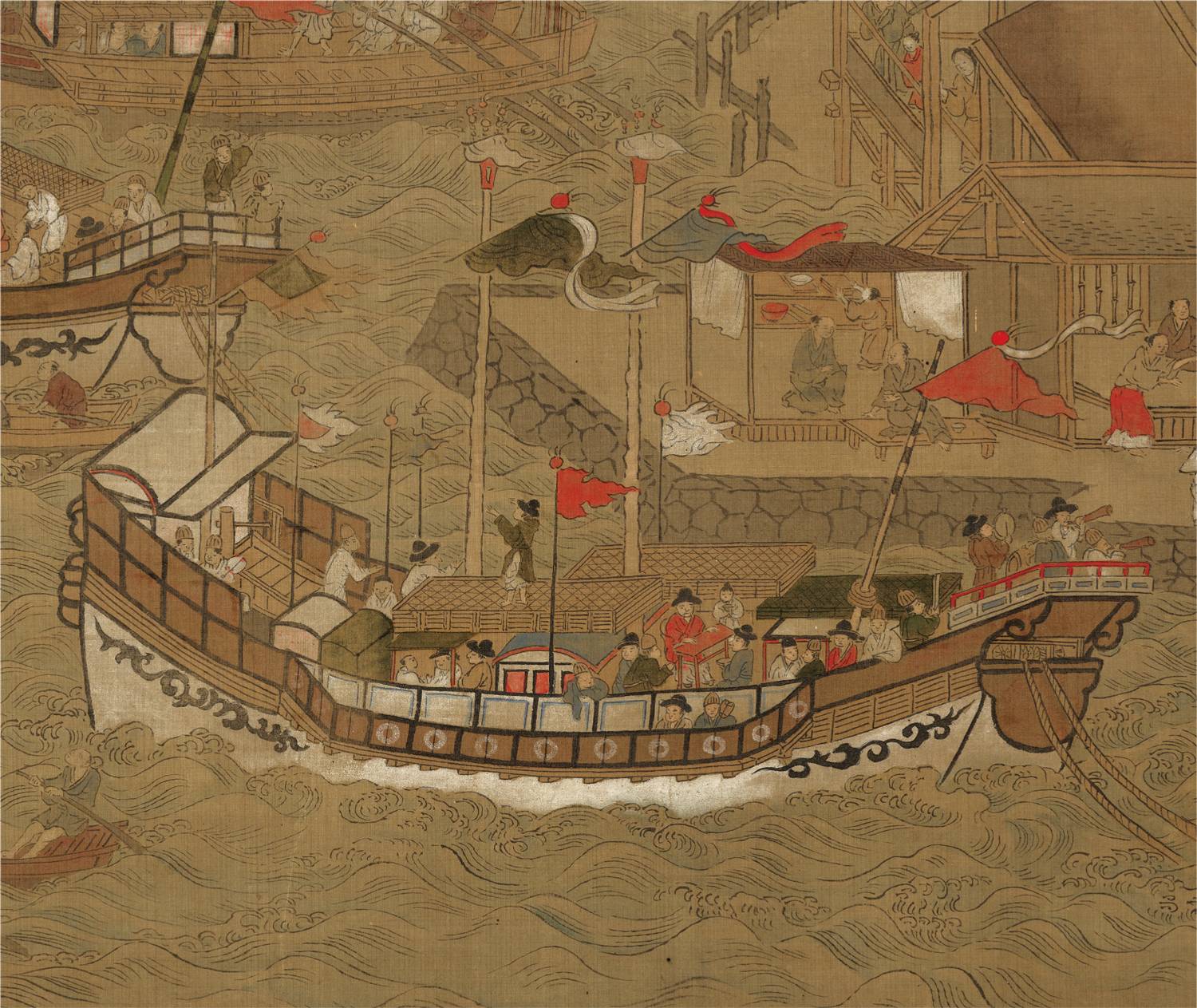
Painting of Joseon Envoys Vessels
This painting depicts the Joseon Envoys Vessels entering a Japanese port, and the surrounding landscape. It shows-on a single canvas-more than 160 people, including members of the Korean diplomatic mission and Japanese people who have gathered at the port to welcome the envoys or observe the rare event, and others who are busy unloading and moving cargoes. Also depicted in the painting are two Joseon Envoys vessels, sails furled and anchors dropped, another ship in the process of lowering its sails, and a number of small Japanese warships(Kobayabune) unloading and transporting cargoes from the missionary ships.
Japan / 18th century / paper
-
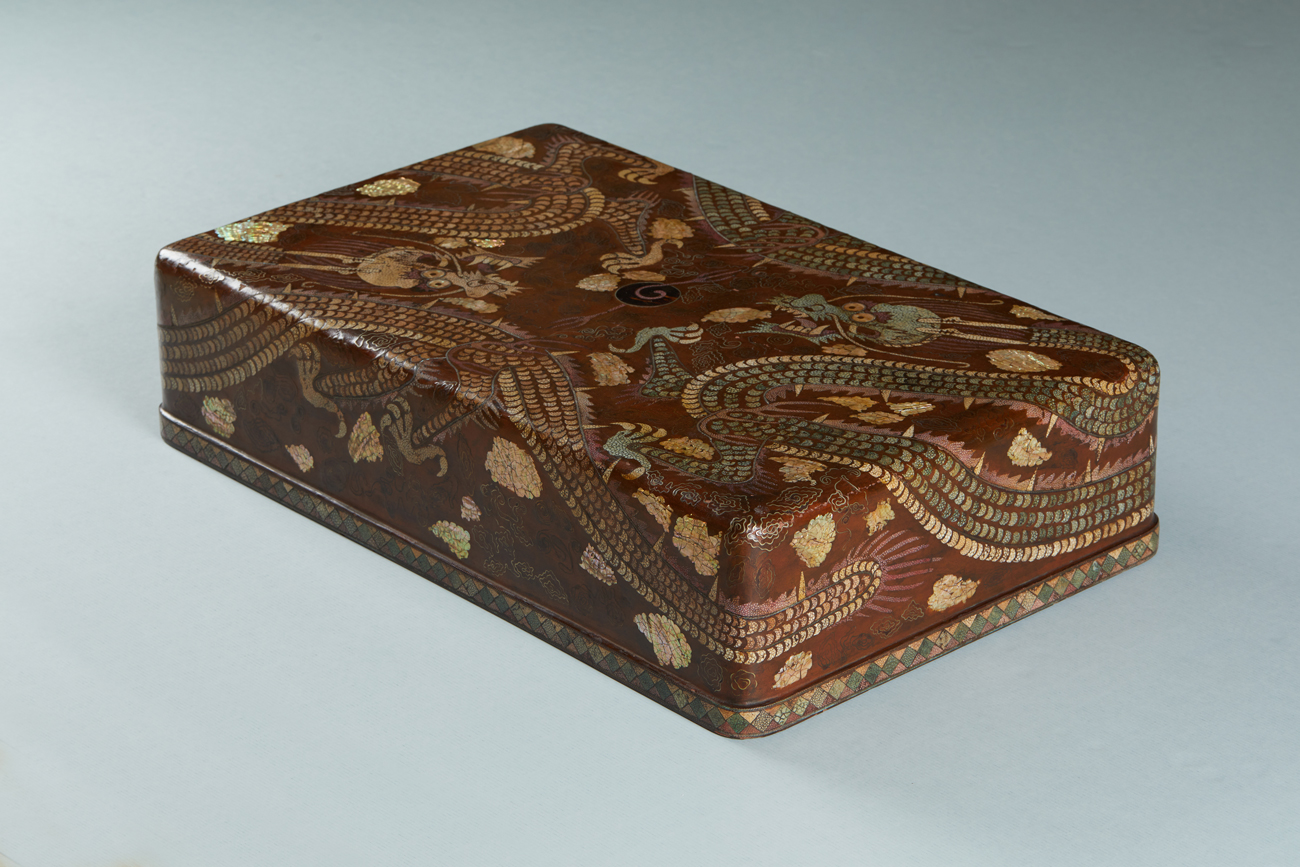
Lacquered Box Inlaid with Mother-of-pearl in a Pattern of Twin-dragon Design
This wooden box was probably used to store garments or other valuable items.Its upper face is decorated with twin dragons embellished with tortoise shell ornamentation that extends to the adjacent faces. The dragon’s scales, mane and belly are decorated with fish skin, while the clouds are decorated with a nacre design, and the edges of the lid with fish skin and lacquering. Similarly, the front part of the interior of the box has a navy blue silk lining with a twin dragon design, which might date back to the late nineteenth century. The decorative features of the box’s front face and its sturdy structure suggest that it was owned by a royal or aristocratic household of Joseon.
Republic of Korea / oseon(19th century) / Metal, wood, nacre, tortoiseshell, fish skin
-
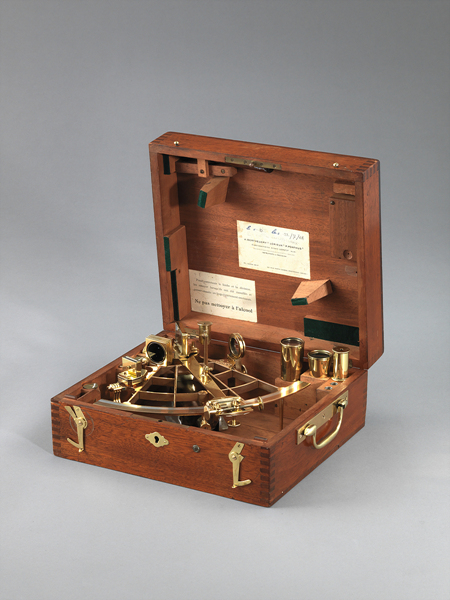
Sextant
This sextant consists of a frame made in the shape of a sector, which is approximately 1⁄6 of a circle(60°), hence its name(sextus is the Latin word for “one sixth”).The sextant is a navigation instrument that is used to measure angular distance in order to find a ship’s longitude and latitude for the purposes of celestial navigation. Holding the sextant in both hands, the navigator uses the telescope to look at the sun or stars through the horizon mirror in order to read the angle.The horizon mirror is round, with half of it blocked and half open, providing a view of the horizon. To obtain an accurate measurement, the navigator positions the horizontal line in the center of the sextant and adjusts it by moving the index arm situated at the end of the sextant. By controlling the angle of the index mirror of the index arm, the images of celestial bodies, such as the sun or moon, are reflected and made visible on the horizon mirror. Then, the navigator can read the angle between the horizon and the celestial object using the sextant’s graduated scale. This scale value must be doubled to obtain the actual angle. Thus, the current latitude can be found easily found by making a calculation using the angle obtained this way, while a ship’s current location can be ascertained by calculating the longitude through the time difference from the prime meridian.
France / 20th century / Metal, glass
-
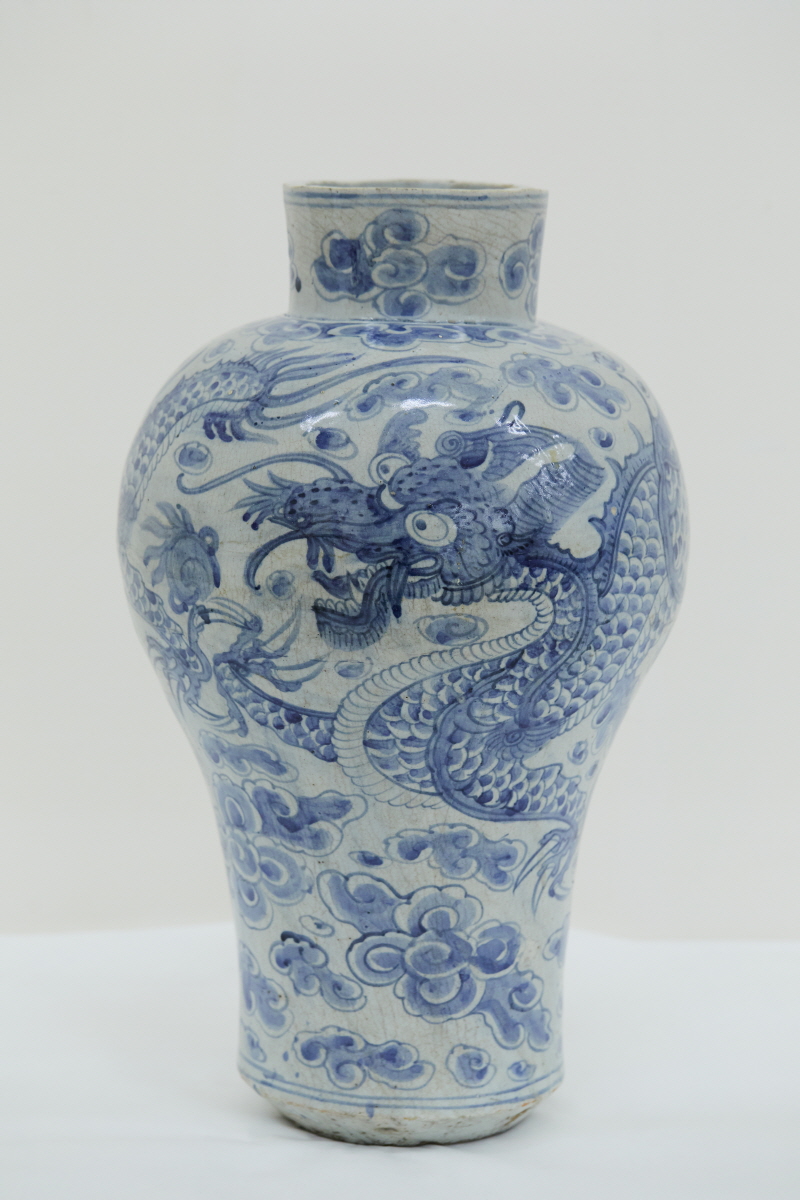
White Porcelain Jar with Cloud and Dragon
This pair of large ceramic jars is lavishly decorated with a dragon motif-a hugely popular style from the late nineteenth to the early twentieth century. The jars have a long, erect neck, a broad shoulder, and a long body tapering towards the base. The mouth is encircled with a lotus band and clouds, while the shoulder is decorated with a cloud and cintamani design. The main part of the body features a design of a dragon full of auspicious energy flying in the clouds. The cobalt blue pigment used to paint the designs is somewhat light, but the dragons are depicted in an expressive manner.
Republic of Korea / Joseon 19th century / Pottery
-
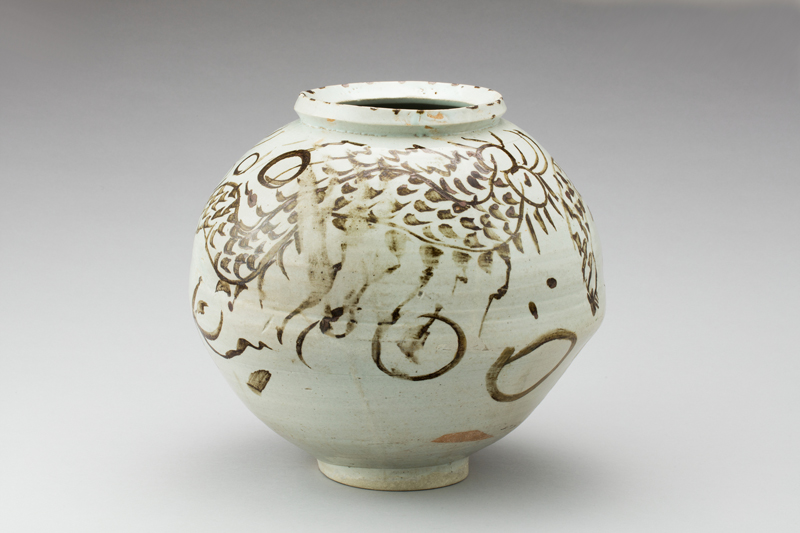
White Porcelain Jar with Cloud and Dragon Design in Underglaze Iron
This white porcelain jar with an iron-painted design was made by combining two hemispherical halves in the middle. Its surface is decorated with a design, painted in oxidized iron pigment, whose motif is a pair of dragons amid clouds. The dragons are characterized by a delightfully simple face with bulging eyes, an antenna-shaped mane, and a body without legs and claws. The scales covering the dragon’s body were expressed with unrestrained brush strokes, without dividing the surface into small, fan-shaped parts. The dragon and cloud motif was also expressed using brusque brush strokes that boldly omit details. In addition, twenty-three dots are stamped in iron oxide slip around the protrusions formed along the lip of the jar.
Republic of Korea / Late Joseon Dynasty / Pottery
-
Military Register of Jeolla-do Province
A military register of Jeolla-do Province recording the personal details of individuals subject to military requisition. The personal details include name, affiliations, place ofesidence, age, face, beard, height, and scars, respectively. Faces were further categorized according to fie diffeent classificationsfor the presence and severity of pockmarks, often left as the vestiges of diseases like smallpox. The egister also lists the armored warships (Geobukseon 二龜船, 龜船, 羅州一龜船), runners (najang), and flag bearers stationed in the coastal regions of Jeolla-do Province, such as Muan, Mokpo, Yeonggwang, Yongam, and Garipo. At the end of the register is the signature of “Commander Kim” (節度使 金).
Republic of Korea / 1855 / paper